The Honest Truth About
Sustainability in 3D Printing
In an age where mindful living and conscious consumption are more important than ever, many of us are questioning how the products we buy are made. 3D printing, a technology often seen as futuristic, is frequently hailed as a solution for more sustainable manufacturing. But what is the honest truth?
Sustainability isn’t a simple yes or no; it’s a series of choices. Here, we’ll explore the pros and cons of 3D printing’s impact on the environment, showing where it truly makes a difference and where the challenges lie.
1. Reduced Material Waste
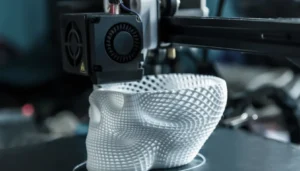
The core principle of 3D printing is that it is an “additive” process, building an object layer by layer. This is a fundamental shift from traditional “subtractive” methods, which start with a large block of material and cut away what is not needed.
The Pro: With 3D printing, you only use the exact amount of material required to create the final product. This dramatically reduces material waste, sometimes by as much as 80-90% compared to traditional carving or molding. It’s a highly efficient way to craft.
The Con: The process is not entirely waste-free. Failed prints, support structures, and the small amount of purge material still create waste. In many cases, this plastic is not recycled and ends up in landfills.
While waste from failed prints is a reality, the overall potential for a near-zero-waste process on a per-product basis is a powerful advantage that far outweighs traditional manufacturing methods.
2. The Biodegradability Question
When we think of sustainable materials, we often think of biodegradable ones. This is a complex area, especially with the most common 3D printing filament, PLA.
The Pro: PLA (Polylactic Acid) is a bio-based plastic, derived from renewable resources like corn starch or sugarcane, unlike conventional plastics which come from petroleum. Under the right conditions, it is industrially compostable. This is a significant step toward using more sustainable feedstock.
The Con: The term “biodegradable” can be misleading. PLA does not break down easily in a home compost pile or a natural environment. It requires specific, high-heat industrial composting facilities to fully decompose, which are not widely available. If it ends up in a landfill, its decomposition process is slow, similar to other plastics.
Using a bio-based material like PLA is a positive step toward reducing reliance on fossil fuels. The conversation around biodegradability is evolving, and it’s a choice that reflects a greater commitment to innovation and more conscious material sourcing.
3. On-Demand Production & Inventory
The global mass-production model often leads to environmental costs long before a product is even purchased.
The Pro: 3D printing enables an on-demand, small-batch manufacturing model. This eliminates the need for large-scale production runs and reduces the risk of over-production. Products are made as they are needed, saving resources, energy, and avoiding the environmental footprint of excess inventory that might otherwise go unsold.
The Con: The cost per unit for 3D printed items can sometimes be higher than for mass-produced goods, which can be a barrier for some customers.
While mass production offers cost-efficiency, the on-demand model is a more intentional way of creating. It respects resources and is a commitment to producing objects that are genuinely wanted, rather than contributing to the environmental cost of surplus goods.
4. Longevity & Timeless Design
True sustainability isn’t just about how a product is made, but also how long it lasts in your home.
The Pro: By its nature, 3D printing allows for incredible design freedom, enabling the creation of unique, durable, and timeless pieces. When an object is well-designed to “fit just right” into your aesthetic and is made with intention, it’s less likely to be discarded in favor of the next trend. It becomes a lasting part of your home.
The Con: In some applications, especially for functional parts under stress, 3D printed items can be more fragile than injection-molded plastics due to layer adhesion. Quality control and design for durability are paramount.
With careful design, material selection, and a focus on quality, 3D printed objects can be highly durable and have a significantly longer lifespan than many fast-fashion goods, promoting a more conscious and sustainable lifestyle.
Sustainability isn’t a single solution, but a collection of thoughtful choices. The power of 3D printing lies in its ability to be a more deliberate choice, one that respects resources and empowers us to create objects with genuine purpose and lasting value.
This is the philosophy that guides every piece we create at Kajo. By embracing the power of 3D printing, we craft objects that not only look beautiful but are born from a process that truly aligns with mindful living.